
How to use a menstrual disc for the first time
A menstrual disc collects period blood inside your vagina. With clean hands, you pinch its rim, guide it back as its instructions show, and tuck the front rim behind your pubic bone. Removal and cleaning matter just as much as putting it in. You can keep using pads if an internal product does not feel right for you.
Already wearing a disc and suddenly unwell? A sudden fever with vomiting, diarrhea, dizziness or a sunburn-like rash can be a sign of rare but serious toxic shock syndrome. Remove the disc if you can and get urgent medical help now with a trusted adult. Do not delay help if it will not come out.
For other pain, irritation or trouble peeing, stop using it and contact a clinician. If you cannot remove it, ask a healthcare professional for help rather than using tools or forcing it. Fainting, severe weakness or severe pain needs urgent help now.
Before your first try
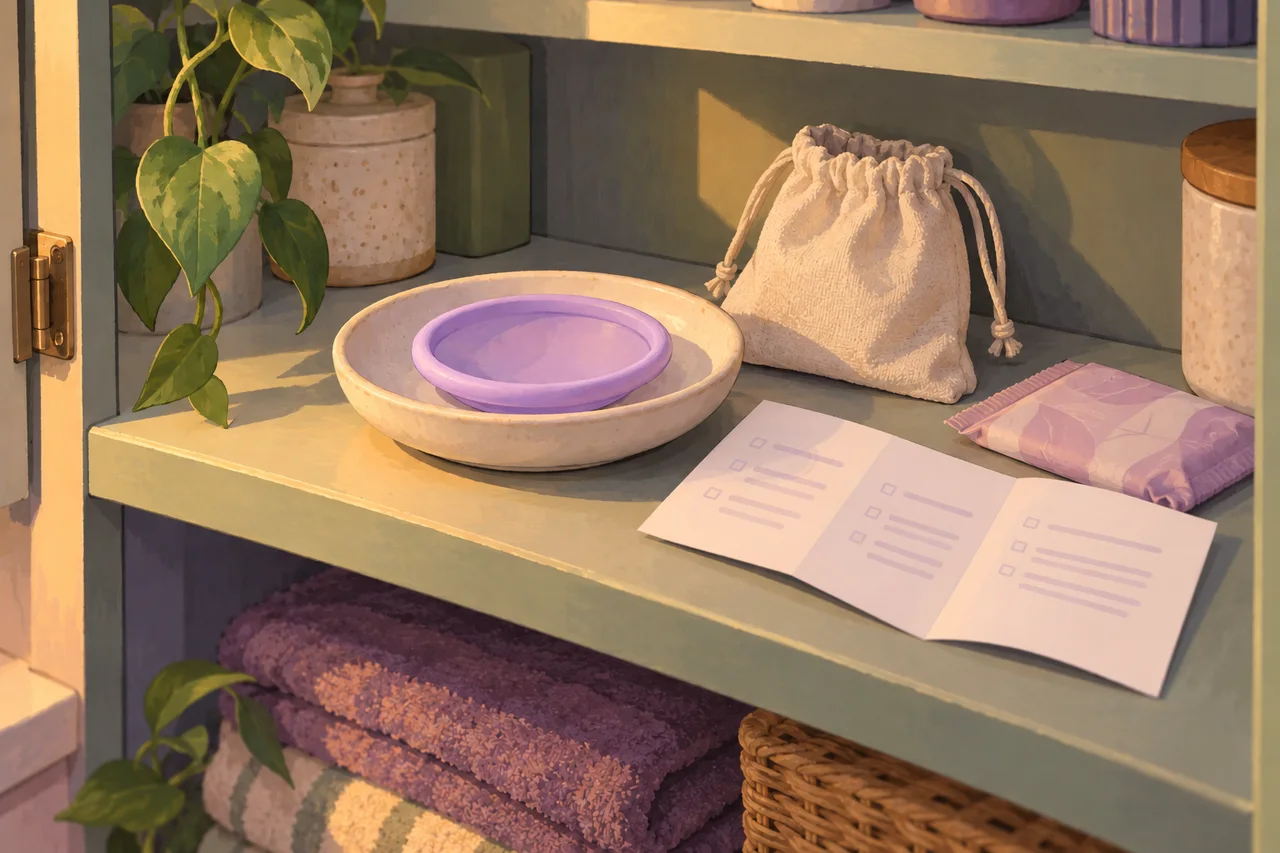
A disc is different from a bell-shaped menstrual cup. It has a wide, shallow basin and a rim that tucks behind the pubic bone. Read the directions for the exact disc you have, including which side faces up and how its removal notch, tab or loop works. Our cup-versus-disc comparison explains that difference.
- Check whether yours is single-use or reusable. Washing a single-use disc does not make it safe to reuse.
- Find its maximum wear time and first-use cleaning instructions. They are not interchangeable between brands.
- Read the removal steps before inserting it. Choose a bathroom where you have time, privacy, clean water and a bin.
- Have a familiar pad or period underwear ready. Switching back is always an option.
A menstrual disc does not prevent pregnancy or protect against sexually transmitted infections (STIs).
Already own a reusable disc and unsure whether it needs replacing? Check how long cups and discs lastbefore planning another use.
How to insert a menstrual disc
Use these steps to understand the routine, alongside your own product’s illustrated directions. Only use an internal menstrual product during your period. Do not keep trying through pain.
- Wash your hands and prepare the disc. Follow its first-use cleaning or sanitizing directions. Inspect it for damage.
- Get comfortable. Sitting on the toilet with your knees apart is one option. Take your time.
- Pinch the rim together. Keep the basin facing the direction shown in the leaflet. Where there is a removal feature, check which end enters last.
- Guide it back gently. Typical disc instructions aim toward your tailbone rather than straight upward. Do not force a disc that will not go in.
- Tuck the front rim. Follow the instructions to position it behind the pubic bone, the firm area toward the front of your vagina. It should feel comfortable.
If you are unsure about placement, remove it gently and use your backup. A clinician can help with persistent discomfort or difficulty; you do not have to work it out in a school stall.
How to remove it
Wash your hands, sit over the toilet and relax. Use a clean finger to find the front rim or the disc’s removal feature. Gently untuck it and slide it out, keeping it level to reduce spills. Hold the rim or the feature named in the directions, rather than pulling on the thin basin.
Empty the collected blood into the toilet. Wrap and bin a single-use disc; never flush it. Clean a reusable one as directed before reinserting. If you cannot reach or remove it, stop forcing it and ask a healthcare professional for help. Do not insert another product while the disc is still inside.
Asking for removal help
I’m using a menstrual disc and I can’t remove it. Can you help me contact a healthcare professional?
How long can you wear a disc, including overnight?
Follow your disc’s own limit. Some U.S. products allow up to 12 hours, but that is a maximum, not a promise that your disc will hold your flow that long. Empty or change sooner if needed. Count from insertion, including time before bed; sleeping does not restart the clock.
A school-day plan: check the label at home, note when you put it in, and choose a bathroom break before its limit. If you cannot manage the required cleaning at school, a familiar outside-the-body product may fit that day better.
What if it leaks?
A leak can mean the disc needs emptying or its position is not right. Check the instructions for orientation and tucking the front rim. Use clean hands, and only make a gentle adjustment that feels comfortable. Persistent leaking is a reason to pause and ask for product-specific advice, rather than buying a bigger size on a guess.
A backup pad or period underwear can help while learning. If bleeding is repeatedly difficult to keep up with, use our heavy-bleeding guide to know when to get medical help.
Cleaning and storage are product-specific
For a reusable disc, follow its washing, rinsing and between-period sanitizing instructions. Let it dry before storing it in the recommended container. Do not copy a boiling time or cleaning recipe from a different product. A single-use disc goes in the bin after use.
Stop using a disc that is damaged. Stop and contact a clinician for itching, rash, swelling, pain or trouble peeing. If you have an IUD or a history of toxic shock syndrome, speak to a clinician before trying an internal product.
You do not need to use a disc to swim, go to school or become “better” at periods. Compare the routines different products involve and choose what you can use comfortably and safely.
Where this comes from
- MedlinePlus: toxic shock syndrome — serious illness signs and seeking immediate medical help
- Intimina: disc orientation and removal — its front/back orientation and removal tab; shape and instructions vary between products
- FDA: menstrual cups and discs — follow the exact product instructions, clean hands and symptoms that mean stopping
- Saalt: disc instructions — disc orientation, tucking the rim, removal, care and troubleshooting for its reusable disc
- Flex: reusable-disc instructions — its wear limit, removal precautions and when to contact a clinician
- Flex: menstrual-disc questions — the difference between single-use and reusable discs, emptying and disposal; not a brand endorsement
Sources checked October 28, 2026. General education, not a diagnosis or personal medical advice. These organizations have not reviewed or endorsed this guide. Tell us about a correction.